

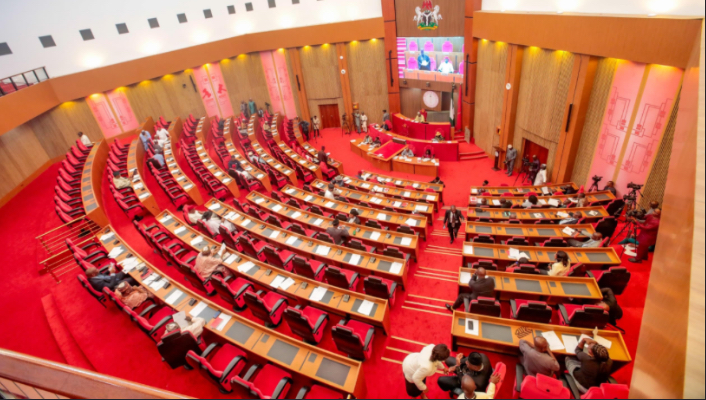
The Senate has approved President Bola Tinubu’s request for a $20.517 billion and €1.045 billion external borrowing plan covering 2026 and 2027, alongside a separate authorisation for the federal government to raise N10.79 trillion in foreign loans to finance the 2026 budget.
The upper chamber also approved a resolution authorising the federal government to implement the N10.79 trillion external borrowing already provided for in the 2026 Appropriation Act, equivalent to $7.707 billion.
The approvals followed the consideration of a report by the Senate Committee on Local and Foreign Debts, presented during plenary by Senator Adetokunbo Abiru (Lagos East) on behalf of the committee chairman, Senator Aliyu Wamakko.
Presenting the report on Tuesday, Abiru explained that the proposed borrowing facilities would provide a financing framework for the federal government, participating state governments and other eligible agencies to engage prospective lenders and negotiate financing arrangements.
He, however, stressed that approval of the borrowing plan should not be interpreted as an instruction to draw down the entire facilities immediately.
According to him, the committee recommended that the funds should be accessed progressively throughout the 2026–2027 plan period, subject to project readiness, negotiated financing arrangements and applicable conditions.
“Consequently, drawdowns should be limited to amounts required for projects scheduled for implementation and financing during the relevant period,” he said.
Abiru said the approach would facilitate orderly project implementation, improve coordination of financing requirements and moderate the immediate impact of the proposed facilities on public debt and debt-servicing obligations.
On the second request, he said the President was seeking legislative authorisation to raise N10.790 trillion, equivalent to $7.707 billion, to partly finance the 2026 Federal Government budget deficit and support projects and programmes captured in the Appropriation Act.
He explained that the amount was already provided for in the 2026 budget and did not constitute an additional borrowing request outside the approved deficit financing.
Contributing to the debate, Deputy Senate President, Senator Barau Jibrin, said the proposed facilities would not be accessed indiscriminately or drawn down immediately.
He said: “It’s not something that is going to draw down immediately. It’s based on requirements. If requirements are fulfilled and the requests are aligned with our national objectives and priorities, then that will be done on individual basis.”
Barau added that the borrowing plan covered state governments as well as the Federal Government.
He argued that the second request was necessary to finance the deficit already approved by the National Assembly, noting that the government needed the funds to implement infrastructure projects and other provisions of the 2026 budget.
He further said Nigeria’s debt-to-GDP ratio could rise to about 42 per cent, which he described as being within the ECOWAS threshold of 70 per cent.
Also, Senator Yahaya Abdullahi (Kebbi North) supported the committee’s recommendations but emphasised the need for proper utilisation of borrowed funds.
He said: “Emphasis should be placed on the recommendation of the committee. And that is one area that I strongly believe we should focus on. That is judicious application of this borrowed money. It is very key.”
He also called for continuous oversight by the Senate and House of Representatives to ensure that the funds were properly applied to approved projects.
In his remarks, Senate President Godswill Akpabio clarified that the N10.79 trillion external borrowing request was part of the broader borrowing framework and should not be regarded as an additional amount outside the previously approved provision.
He explained that the separate resolution was intended to enable the Debt Management Office (DMO) to commence negotiations with prospective lenders and facilitate access to the funds for the implementation of the 2026 budget.
Akpabio said: “This approval that is being granted under two is part of the approval granted in one. It is not a new addition.”
He added that the distinction was necessary to prevent the public from wrongly aggregating the two figures as separate borrowing facilities.
The Senate subsequently approved the two requests through voice votes.
It also authorised the Federal Government to raise the approved borrowing through one or a combination of concessional and commercial financing windows offered by multilateral and bilateral institutions, the International Monetary Fund, bridging finance facilities, loan syndication and Eurobond issuance.
However, the approvals were made subject to conditions requiring the Federal Government, through the DMO, to submit periodic reports to the National Assembly on financing arrangements concluded.
The reports are expected to contain details of amounts raised, sources of financing, interest rates, repayment periods, associated fees and other relevant terms and conditions.
The Senate also mandated its Committee on Local and Foreign Debts to exercise continuous oversight over the borrowing programme, including monitoring actual drawdowns, utilisation of proceeds and compliance with conditions approved by the National Assembly.
Akpabio directed the Clerk of the Senate to prepare two separate approval letters for the President, incorporating the conditions attached to the resolutions.
He said the separation was necessary to distinguish approval of the broader borrowing plan from the resolution facilitating negotiations for the external borrowing component of the 2026 budget.
The Senate President commended the committee, particularly Wamakko and Abiru, for presenting the report and clarifying the issues surrounding the borrowing requests.
We’ve got the edge. Get real-time reports, breaking scoops, and exclusive angles delivered straight to your phone. Don’t settle for stale news. Join LEADERSHIP NEWS on WhatsApp for 24/7 updates →