

By Alumona Ukwueze
ENUGU—-Former Governor of old Anambra State and former Minister of Sports, Chief (Dr.) Jim Ifeanyichukwu Nwobodo, has urged the Enugu State University of Science and Technology (ESUT) to prioritise research, technological innovation, entrepreneurship and good governance to enhance its contribution to national development.
Nwobodo made the call while delivering the 3rd Distinguished Personality Lecture of ESUT during the university’s Special Convocation Ceremony at its permanent site at Ebe-ano City, Enugu State.
The lecture was titled, “From Vision to Legacy: Technology, Education, Leadership, Good Governance and the Responsibility of a New Generation.”
Nwobodo, who founded the Anambra State University of Science and Technology (ASUTECH) in 1980, said the establishment of the institution was a deliberate investment in the future, driven by the conviction that education, scientific knowledge, technological competence and visionary leadership were essential to societal progress.
He expressed satisfaction with the growth of the university, noting that the institution’s continued development more than four decades after its establishment demonstrated the enduring value of its founding vision.
According to him, the true measure of leadership goes beyond achievements recorded while in office to include the institutions established and the opportunities created for future generations.
Reflecting on his experience in public service, Nwobodo said governments and political office holders might come and go, but institutions founded on sound principles and sustained through responsible governance could endure for generations.
He stressed that visionary leadership required the courage to make difficult decisions and undertake initiatives whose benefits might extend beyond one’s tenure in public office.
On the future of ESUT, the former governor called for its transformation into a leading centre for research, innovation, entrepreneurship, technological development and practical solutions to societal challenges.
He said the university’s success should not be measured solely by student enrolment and graduation figures but also by the quality of its research, technological discoveries, entrepreneurial achievements and contributions to national development.
Nwobodo advocated increased investment in applied research, urging engineering students to develop solutions to energy and infrastructure challenges, agricultural scientists to improve food production, medical researchers to advance healthcare, and computer scientists to develop applications in artificial intelligence, cybersecurity and digital technology.
He also called for stronger collaboration among students of management, law, economics and social sciences and their counterparts in science and engineering to translate research findings into commercially viable enterprises.
The former minister further urged the university to strengthen its partnerships with government, industries, investors, research institutions and alumni.
He specifically encouraged ESUT to establish or strengthen a dedicated centre for innovation and entrepreneurship where students, researchers and industry partners could transform promising ideas into products, businesses and practical solutions.
Nwobodo also underscored the importance of alumni participation in the university’s development, calling for stronger partnerships between the institution and its graduates through scholarships, research endowments, mentorship, industry partnerships, internships and support for entrepreneurship.
He said alumni who had distinguished themselves in business, industry, technology, academia and public service possessed valuable knowledge, professional networks and resources that could strengthen the university.
On technology and leadership, Nwobodo cautioned that technological competence must be accompanied by critical thinking, ethical judgment, responsible leadership and an understanding of society.
He noted that although artificial intelligence could process information at extraordinary speed, human beings must remain accountable for decisions made with its assistance.
“Technology determines what society is capable of doing. Leadership, values and governance determine how that capability is used,” he said.
He therefore urged universities to produce not only technologically competent graduates but also knowledgeable, innovative and ethical citizens capable of applying technology in the service of humanity.
Addressing the issue of good governance, Nwobodo said effective leadership required transparency, accountability, competence, fairness, respect for the rule of law and responsible management of public resources.
He maintained that public office was a position of trust that must be exercised in the public interest.
The former governor further stressed the need for continuity in institutional development, warning that when successive administrations abandoned the worthwhile initiatives of their predecessors, development became discontinuous and difficult to sustain.
He said institutions must be stronger than individuals and establish systems that preserve continuity, merit and accountability beyond changes in leadership.
Nwobodo noted that ASUTECH was established under an administration that eventually ended, but its educational vision endured because successive generations contributed to its development.
He urged the university community, particularly graduating students, to embrace leadership founded on integrity, responsibility, sound judgment and service to society.
The Governor of Enugu State, His Excellency, Dr. Peter Mbah praised Nwobodo’s vision and courage in leadership, especially for investing heavily in human capital development, taking the bold step to establish ESUT a few years after the civil war, not minding the enormity of the challenges involved.
“I have often wondered what it must have felt like to be governor in 1979. Nigeria had just returned to civilian government after thirteen years of military rule.
“The Civil War had ended less than a decade earlier, and the country was still dealing with its consequences. There was much to rebuild, and enormous pressure on the resources available to government.
“For many families, university education remained beyond their reach. And here was a young governor, who decided that his state should establish a university of science and technology.
“People questioned whether it could be done. Was there enough money? Could a state government sustain such an institution? Shouldn’t this be left to the federal government?,” the Governor said.
Earlier in his welcome address, the Vice Chancellor of ESUT, Professor Aloysius-Michaels Okolie, lauded the contribution of Senator Nwobodo, to the education sector, stating that “he dared to establish the first University of Technology in Nigeria.”
“Today, 46 years after, that seed had grown into a giant, producing thousands of scientists, engineers, doctors, managers and leaders serving Nigeria and humanity in various capacities. We are forever grateful, Sir.
“As the first civilian Executive Governor of old Anambra State (1979-1983), Senator Nwobodo broke all records of achievements and laid foundation of modern Anambra and Enugu States respectively. Your incredible footprints are still visible,” he said.
Equally, the Chairman of the Local Organizing Committee for the Lecture, Professor Okechukwu Oji, while welcoming guests at the event, stated that the Distinguished Personality Lecture Series was conceived by the University to bridge the gap between the town and gown and to address burning issues of public interest for the benefit of society.
He further stated that the Lecturer, Senator Nwobodo, given his wealth of knowledge and experience in leadership, politics and governance, as well as his God-given wisdom would do justice to the topic.
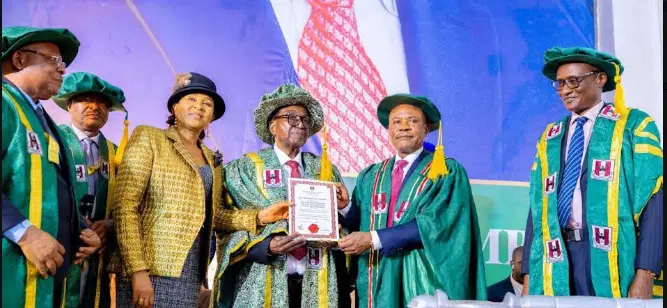
Honorary Doctorate Award for Leadership, Governance and Human Capital Development – Honoris Causa was conferred on Senator Nwobodo by ESUT during the lecture.
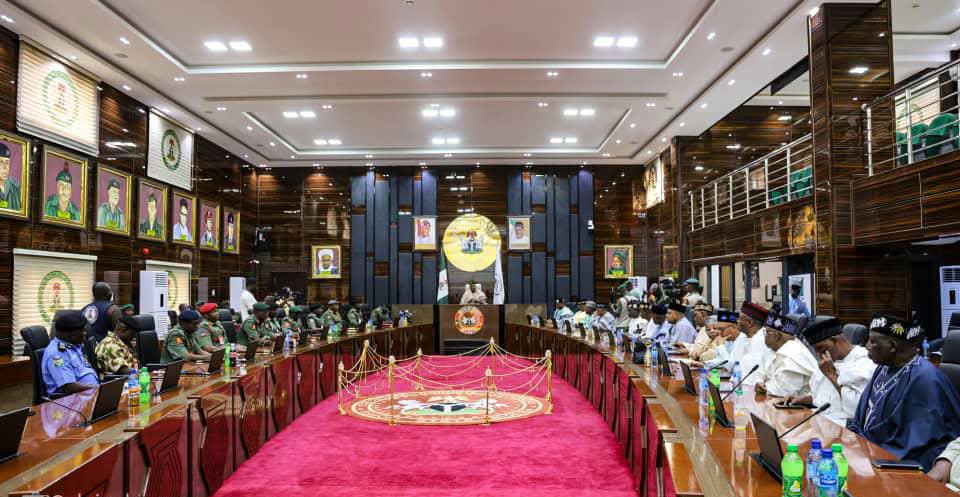
The lecture drew dignitaries including the Visitor to the University and Governor of Enugu State, Dr. Peter Mbah, ministers, commissioners and other critical stakeholders to ESUT.