

Nigeria has secured a significant international milestone for the country’s marine and blue economy, following its formal ratification of a landmark United Nations treaty on the conservation and sustainable use of marine biodiversity in areas beyond national jurisdiction.
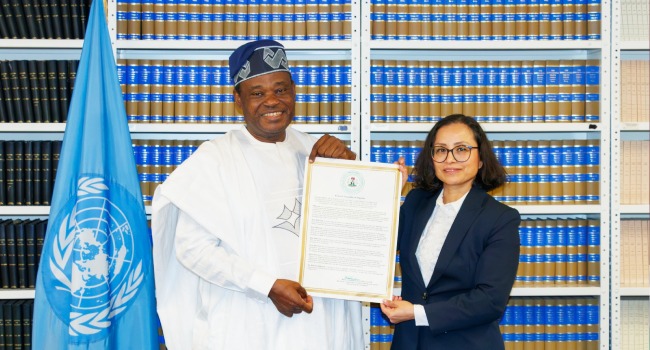
The historic instrument of ratification was deposited on behalf of President Bola Tinubu by Nigeria’s Permanent Representative to the United Nations, Jimoh Ibrahim, at the United Nations Headquarters in New York.
Speaking at the ceremony, Ibrahim highlighted the economic and strategic importance of the agreement to Nigeria, noting that it would expand the country’s opportunities to benefit from ocean resources through greater participation in the governance of the high seas.
The Biodiversity Beyond National Jurisdiction (BBNJ) Agreement, also known as the High Seas Treaty, provides a framework for the protection, management and sustainable use of marine resources in areas beyond national jurisdiction.
For Nigeria, a coastal nation along the Gulf of Guinea, the agreement marks a significant step towards strengthening its marine economy, protecting biodiversity, supporting fisheries and unlocking opportunities in emerging ocean-based industries.
A major implication of the ratification is Nigeria’s plan to develop a proposal for the establishment of a highly protected marine area on the high seas.
The initiative is also expected to strengthen efforts to conserve marine ecosystems while promoting the fair and equitable sharing of benefits from ocean resources, particularly for developing countries.
Nigeria signed the BBNJ Agreement on May 3, 2024.
Following the deposit of its instrument of ratification, the agreement will enter into force for Nigeria on December 24, 2026.
This will enable the country to participate as a full Party at the first Conference of the Parties, scheduled to open on January 11, 2027.
At the ceremony, Ibrahim acknowledged Evelyn Campos Sanchez, Officer-in-Charge of the United Nations Treaty Section, for receiving Nigeria’s instrument of ratification.
Nigeria’s commitment to the agreement is further reinforced by the establishment of the Federal Ministry of Marine and Blue Economy, alongside the adoption of a National Blue Economy Policy and a national roadmap for implementing the treaty.
As a party to the agreement, Nigeria will continue to advocate for the fair and equitable sharing of benefits arising from marine genetic resources and digital sequence information.
The country will also push for stronger capacity-building initiatives and the transfer of marine technology to African and other developing nations.
Ambassador Ibrahim further noted Nigeria’s support for the establishment and effective operation of a Special Fund with adequate and predictable resources to enable developing countries to implement the agreement.
He also called on countries yet to ratify the treaty, particularly African nations, to do so, pledging Nigeria’s commitment to working with the African Group towards a successful inaugural Conference of the Parties.
The ratification marks a strategic step in Nigeria’s efforts to strengthen its position in global ocean governance, protect marine resources and translate the vast economic potential of the blue economy into sustainable national development.