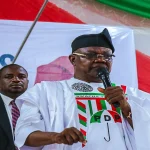



The Nigerian Export-Import Bank (NEXIM) has disclosed that it has mobilised N42 billion in partnership with the Small and Medium Enterprises Development Agency of Nigeria (SMEDAN) to strengthen small businesses’ capacity to access export markets.
The managing director and chief executive officer of NEXIM Bank, Abubakar Bello, made this known on Thursday at the bank’s 2026 Stakeholder Engagement Forum in Abuja, where he outlined the financial and structural challenges confronting Nigerian exporters.
He said the funding initiative was designed to help small businesses operating across the export value chain expand their operations and improve their ability to trade successfully within and beyond Africa.
“Just last week or two weeks ago, NEXIM, in collaboration with SMEDAN, sourced the equivalent of N42 billion just for our small businesses that need the export value chain to be scaled so that they can do their exports smoothly and successfully,” Bello said.
He identified high energy costs, inadequate infrastructure, inefficient ports, limited access to finance and regulatory bottlenecks as major constraints limiting the ability of Nigerian businesses to compete effectively in international markets.
“High energy costs, inadequate infrastructure, inefficient ports, limited access to finance, and regulatory bottlenecks still hold us back. And we must confront them decisively,” he said.
Bello warned that Nigeria’s ability to benefit from the African Continental Free Trade Area (AfCFTA) would depend largely on the productive capacity of its businesses, noting that opening access to a larger market would not automatically translate into increased exports.
“Trade agreements open markets, but competitiveness determines who succeeds in them,” he added.
He disclosed that NEXIM had supported more than 1,300 non-oil export transactions valued at over N800 billion since its establishment in 1991, helping to create and sustain approximately 110,000 industrial jobs.
According to him, Nigeria’s non-oil exports reached a record $6.1 billion in 2025, while the country’s trade with other African nations rose by 21 per cent to $9.02 billion.
He, however, expressed concern over Nigeria’s continued reliance on raw commodity exports, arguing that the country needed to strengthen local processing and manufacturing to capture greater value from its natural and agricultural resources.
“Our challenge, therefore, is not simply to export more but to produce more,” he said.
Bello identified cocoa, sesame, cashew, cotton, ginger, shea and cassava as agricultural commodities with significant potential for value addition, alongside opportunities in pharmaceuticals, building materials, financial technology and entertainment.
He also disclosed that NEXIM was working with the Islamic Development Bank to mobilise additional funding and establish a non-interest financing facility for businesses.
He said the bank was equally expanding specialised financing opportunities for women and young entrepreneurs to widen participation in export-oriented economic activities.
Meanwhile, the Minister of Finance and Coordinating Minister of the Economy, Taiwo Oyedele, called for export financing arrangements that take account of the payment cycles and operational requirements of businesses.
He said financing conditions that required exporters to repay loans before receiving payment for their transactions could create unnecessary pressure on businesses.
“Finance must fit the transaction cycle. A facility that matures before the exporter is paid creates avoidable pressure,” Oyedele said.
The minister said the Federal Government was working to address infrastructure deficiencies, high transaction costs, inadequate trade financing and non-tariff barriers affecting businesses engaged in cross-border trade.
Also speaking, the Governor of the Central Bank of Nigeria, Olayemi Cardoso, said Nigeria needed to improve the quality and value of its exports rather than concentrate solely on increasing export volumes.
“Our ambition must extend beyond increasing export volumes. Nigeria must increase the value, sophistication, and competitiveness of what it exports,” Cardoso said.
He urged development finance institutions to deploy financial guarantees, insurance and risk-sharing instruments to encourage commercial banks to provide more credit to exporters.
In her remarks, the National Coordinator of the Nigeria AfCFTA Coordination Office, Patience Okala, said interventions to improve regional transportation had started reducing the cost of moving goods across African markets.
She cited air cargo corridors established with Uganda and Rwanda, which she said had significantly reduced freight charges for participating businesses.
“When they used to pay $4 for one kilo, they now pay $1.20 per kilo,” Okala said.
She added that 85 per cent of reported non-tariff barrier complaints received within four months had been resolved, while the processing time for certificates of origin had dropped from five days to 24 hours.
Similarly, the Special Adviser to the President on Economic Affairs, Tope Fasua, called for greater investment in electricity, transportation infrastructure, technology and skills development to improve the productive capacity of Nigerian industries.
“Market access without productive capacity is an invitation to import, not an assurance of export success,” Fasua warned.
We’ve got the edge. Get real-time reports, breaking scoops, and exclusive angles delivered straight to your phone. Don’t settle for stale news. Join LEADERSHIP NEWS on WhatsApp for 24/7 updates →