

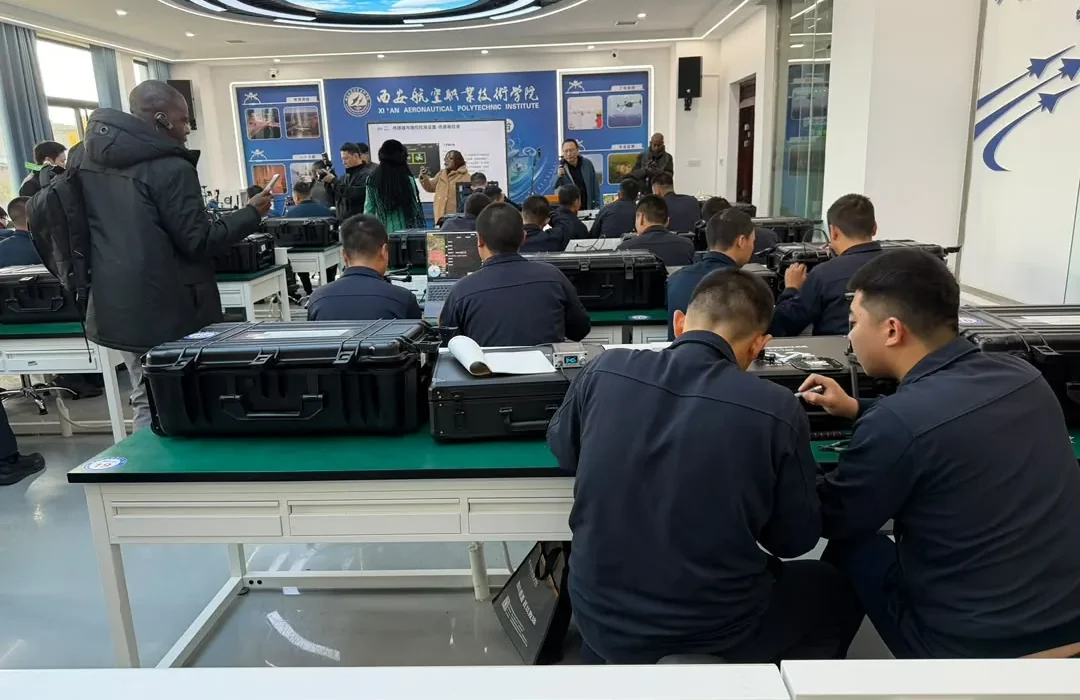
I must confess, I was not quite prepared for what I saw during my visit to the Qinling Workshop at Xi’an Aeronautical Vocational and Technical College in China.
For someone fascinated by technology and innovation, walking into the institution’s aircraft hangar was an experience in itself. There were aircraft and helicopters, aviation equipment and specialised training facilities. For a moment, it felt less like visiting a school and more like stepping into an aviation engineering centre.
But the biggest surprise was yet to come.
Beyond the aircraft and helicopters, I encountered something that left an even stronger impression: drones designed, developed and assembled by students.
These were not simply classroom models or academic projects put together to earn grades. The students were experimenting with different drone technologies, exploring their applications and developing solutions to practical problems.
There were different designs and innovations, reflecting the creativity, technical confidence and curiosity of young people who were not waiting until graduation to start making a contribution to society.
It was exciting to see.
One could immediately imagine the possibilities: drones that could help farmers monitor crops and spray farmlands, support environmental monitoring, conduct aerial surveys, inspect infrastructure and assist emergency response operations.
What struck me most was the philosophy behind what I was seeing. Technology was not being taught as an abstract subject. Students were being encouraged to understand problems and develop technological solutions.
An institution built around practical skills
The Qinling Workshop visit offered an opportunity to appreciate the work of Xi’an Aeronautical Vocational and Technical College, an institution with a strong focus on aviation, engineering and technical education.
Its programmes cover a wide range of disciplines, including aviation manufacturing, aircraft maintenance, aircraft engine technology, drone application technology, general aviation, mechanical engineering, artificial intelligence, computer technology, robotics, automation, electronic information, aviation logistics and automotive technology.
Students also study specialised areas such as CNC machining, intelligent manufacturing, aircraft electronic systems, materials engineering, welding technology, surveying and remote sensing, software development, big data, airport operations and civil aviation services.

The breadth of these programmes is significant. It shows an understanding that an aviation and manufacturing economy requires much more than pilots and aircraft engineers. It needs technicians, software developers, mechanics, materials specialists, electronics experts, maintenance professionals and people who can design, manufacture and repair equipment.
The institution has developed specialised workshops, laboratories and practical training facilities to support this approach.
What makes the model particularly interesting is the government’s involvement in supporting vocational education. The college operates within China’s publicly supported technical education system, with government funding and student support arrangements helping to make technical training more accessible. I was particularly interested in learning about the tuition subsidies available to students.
This is an important development consideration. Technical education requires expensive equipment, specialised instructors and facilities that many students and families may struggle to afford without institutional and government support.

China’s investment in this area reflects an understanding that producing skilled technicians is not simply an educational responsibility. It is also an economic and industrial priority.
Investing in China’s young people
One thing I noticed was that the student population was predominantly Chinese, with relatively few international students.
This is significant because it shows that the institution’s primary focus is developing the technical skills of China’s own young population.
The young people I encountered were being equipped with practical knowledge that could feed directly into the country’s aviation, manufacturing, technology and industrial sectors.
There is an important lesson here for developing countries.
Education should not only prepare young people to search for jobs. It should also equip them with the capacity to create products, provide services, solve problems and contribute to economic growth.
A country that wants to industrialise needs more than university graduates. It needs a large pool of technically competent people who understand how things work and, more importantly, how to make them work.

The drones I saw were a practical illustration of this thinking. A student who can design and assemble a drone, programme its flight systems and identify its possible applications is acquiring skills that can be translated into economic opportunities.
What Nigeria can learn
My visit inevitably brought Nigeria to mind.
We have universities, polytechnics, colleges of technology and technical schools offering courses in engineering, agriculture, computer science and related disciplines. We also have young people with enormous creative potential.
But there is a need to strengthen the connection between what students learn in classrooms and the practical demands of the economy.
Imagine a Nigerian polytechnic where agricultural technology students work with engineering and computer science students to develop drones for farmers. Imagine students designing affordable machinery for small-scale manufacturers, developing solar-powered equipment for rural communities or creating digital solutions for transportation and healthcare.
These are not unrealistic ambitions. They are possibilities that can emerge when education is properly connected to innovation.
There are several areas where our institutions can learn from this experience.
First, we need to invest more deliberately in practical training facilities. Engineering students should have access to functioning laboratories, workshops, machinery and opportunities to develop prototypes. A student studying drone technology, for instance, should have opportunities to design, assemble, programme and test drones.

Second, we need stronger partnerships between educational institutions and industry. Companies should participate in curriculum development, provide equipment, offer internships and give students real problems to solve.
Third, we should encourage multidisciplinary innovation. A drone project may require expertise in electronics, software engineering, mechanical engineering, artificial intelligence, geography and agriculture. Bringing students from different disciplines together can produce solutions that would otherwise be difficult to achieve.
Fourth, government support for technical education deserves greater attention. If we want more young Nigerians to acquire specialised skills, we must make vocational and technical training affordable and accessible. This requires investment in facilities, scholarships, tuition support, instructors and industry partnerships.
An opportunity for Nigeria-China cooperation
There is also an opportunity to take this relationship beyond trade and infrastructure into education and technology transfer.
Nigeria and China could explore partnerships between technical institutions, including student and faculty exchanges, joint research, scholarships, specialised training and the development of practical training centres.
Our institutions could benefit from Chinese expertise in aviation maintenance, drone technology, robotics, artificial intelligence, advanced manufacturing and automation.
International cooperation should, however, go beyond sending a few students abroad to acquire certificates. We should explore arrangements that allow knowledge, training capacity, equipment and technology to be transferred to Nigerian institutions.
For instance, a Nigerian polytechnic could partner with a Chinese technical institution to establish a specialised drone technology or advanced manufacturing centre. Chinese instructors and technical experts could support the initial training of local instructors, who would eventually take ownership of the programmes.
This would create a more sustainable model of cooperation.
For international students, institutions like this also offer opportunities to acquire specialised skills in a country with a substantial manufacturing and engineering ecosystem. Although the student population I encountered was predominantly Chinese, the international dimension of such educational partnerships offers possibilities for Nigerian students seeking technical expertise.
The ultimate objective should be to ensure that whatever knowledge our students acquire can be applied to the needs of our economy.
The future belongs to problem-solvers
As I left the workshop, one thought stayed with me: the real measure of education is not simply the number of certificates we award, but the capacity we build in people to solve problems.
China’s technological progress is supported by an ecosystem in which education, industrial production, research and practical innovation reinforce one another. It is an approach from which developing countries, particularly those in Africa, can draw useful lessons.
Nigeria does not necessarily have to reproduce China’s model in every detail. Our circumstances, resources and priorities are different. But we can learn the importance of investing in practical skills, encouraging experimentation and making education relevant to the challenges of our society.
Imagine Nigerian students developing drones to help farmers improve productivity, creating affordable machines for small businesses, designing technology for rural healthcare or building systems to address problems in transportation, energy and environmental management.
These possibilities are not beyond our young people.
What they need are the right opportunities, facilities, mentorship, investment and an educational system that gives creativity room to flourish.
My visit to the Qinling Workshop was a reminder that the future is not simply something we wait for. It is something we equip young people to build.
And sometimes, the most exciting evidence of a country’s technological ambition is not found in its biggest factories or most impressive skyscrapers, but in a school workshop where young students are already building the solutions of tomorrow.
UPDATE NEWS:
Nigerians can now invest ₦2.5 million on premium domains and profit about ₦17-₦25 million. All earnings paid in US Dollars. Rather than wonder,
click here to find out how it works.