

…infrastructure decay is enormous, says minister
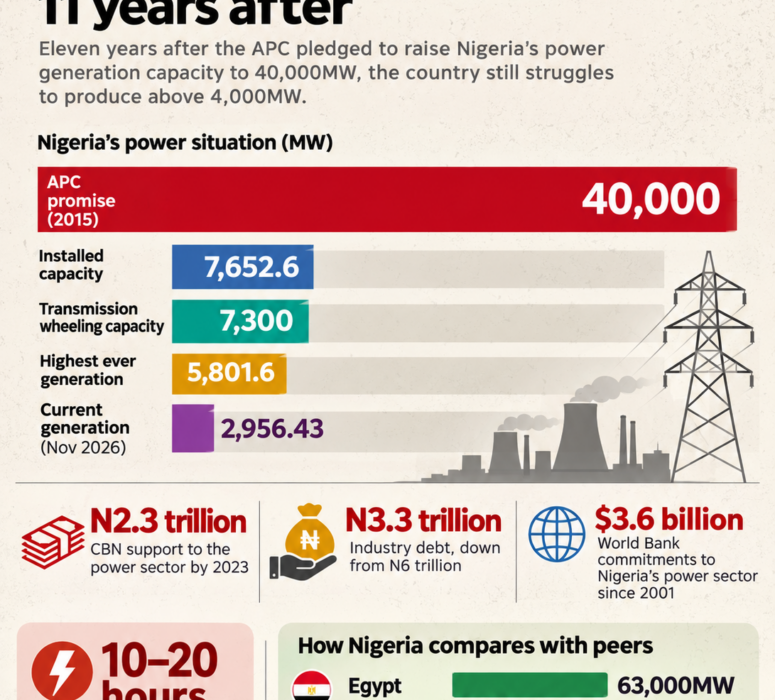
Eleven years after the All Progressives Congress (APC) came to power on a pledge to end Nigeria’s electricity crisis by expanding generation capacity to 40,000 megawatts (MW), Africa’s most populous country still struggles to generate more than 4,000MW for its over 200 million people.
Trillions of naira spent on interventions under the late President Muhammadu Buhari and his successor, Bola Tinubu, have done little to change that reality.
According to the Nigerian Electricity System Operator, total electricity generation stood at 2,956.43MW at 1 pm on Monday.
This compares with an installed generation capacity of 7,652.6MW and a transmission wheeling capacity of 7,300MW. The highest generation output ever recorded on the national grid is 5,801.6MW.
Chronic electricity shortages have plagued Nigeria for decades, with promises to resolve the crisis featuring prominently in successive election campaigns, including Buhari’s 2015 presidential campaign.
The APC’s 2015 manifesto, seen by BusinessDay, pledged to expand electricity generation and distribution capacity to 40,000MW within four to eight years.
In Section 4 of the 31-page manifesto, the party specifically promised to take steps to increase the country’s electricity generation capacity to 40,000MW within the period.
“Our government shall vigorously pursue the expansion of electricity generation and distribution of up to 40,000 megawatts in four to eight years,” the APC said.
Buhari reinforced that commitment after assuming office, telling the National Economic Council retreat in Abuja on March 21, 2016, that his administration had set a target of 10,000MW of distributable electricity.
“We have given ourselves the target of 10,000 megawatts of distributable power. In 2016 alone, we intend to add 2,000 megawatts to the national grid,” he said.
Neither target has come close to being achieved.
Read also: Nigeria’s electricity crisis and the unfinished business of reform
Five power ministers, little progress
Since 2015, the APC-led Federal Government has appointed five ministers of power, beginning with Babatunde Fashola, the former Lagos State governor, who served for four years while also overseeing the Works and Housing ministry.
After Buhari’s re-election in 2019, he appointed Saleh Mamman as minister of power following the restructuring of the ministry. Mamman served until 2021, when he was removed by the president.
Mamman was subsequently convicted by the Federal High Court in Abuja on money laundering and fraud charges involving more than N33.8 billion linked to power projects. He was sentenced to 75 years in prison.
He was succeeded by Abubakar Aliyu in 2021, who remained in office until the end of Buhari’s administration. However, electricity supply remained unreliable during his tenure.
Following Tinubu’s election in 2023, Adebayo Adelabu was appointed minister of power. His tenure was marked by persistent criticism over worsening electricity supply and the sector’s inability to meet the needs of households and businesses.
Adelabu resigned in 2026 to contest the Oyo State governorship election and was succeeded by Joseph Tegbe.
Tegbe acknowledged on Monday that the scale of the electricity infrastructure deficit was far greater than the government initially understood, saying the problems extended beyond generation to the transmission and distribution networks.
“Infrastructure decay is enormous. These things have happened over 50 years. Don’t expect us to fix it in two years,” he said during an interview on Arise TV monitored by BusinessDay.
Tegbe also criticised previous government spending decisions, arguing that investments had not been directed towards the most critical areas of the electricity value chain.
“From a technical point of view, I will tell you the biggest issue is that we’ve been throwing money at the wrong things. We have not worked prioritising things in the past. Some of the decisions that have been made by previous governments have been driven by political reasons,” he said.
The ministry is reviewing existing projects to determine which should receive priority funding, particularly those capable of improving electricity supply to consumers, he said.
BusinessDay’s findings showed that the Central Bank of Nigeria had channelled more than N2.3 trillion into the power sector by 2023, covering infrastructure, metering and support for generation and distribution companies.
Tinubu’s administration has also attempted to address outstanding obligations to power generation companies, negotiating a reduction in the industry’s debt from N6 trillion to N3.3 trillion.
Read also: Nigerian upstream firms spend N588.3bn to service debts amid rate cut
By April, the government had paid N1.23 trillion and was working towards settling the outstanding balance through other arrangements.
“It is absolutely unacceptable that in 2026, after trillions have been sunk into the power sector, we still can barely generate 3,000 MW,” said James Harry, coordinator of the Association of Electricity Customers Monitoring Network.
Foreign money, few results
Foreign lenders have also committed billions of dollars to Nigeria’s electricity sector, but the financing has yet to translate into reliable power supply.
Since 2001, the World Bank has committed more than $3.6 billion to the sector through loans, guarantees and financing facilities covering rural electrification, renewable energy and high-voltage transmission infrastructure.
The Transmission Development Project, launched in 2001, received $100 million to upgrade the national grid. The National Energy Development Project followed in 2005 with $172 million, while the Nigeria Electricity and Gas Improvement Project received $400 million in 2009 to address generation and gas supply constraints.
In 2014, the Power Sector Guarantees Project adopted a different approach, providing $145 million in guarantees to attract private investment and protect electricity generators against payment risks arising from weaknesses in the distribution segment.
Despite these interventions, the average Nigerian household still endures between 10 and 20 hours of power outages daily, according to BusinessDay’s findings.
Factories, hospitals and small businesses continue to rely heavily on petrol and diesel generators, sustaining a parallel energy economy that costs an estimated $25 billion annually in lost productivity and fuel expenditure, based on government and multilateral estimates.
Energy experts and lawyers surveyed by BusinessDay said more than two decades of reform programmes and multilateral financing had failed to resolve structural weaknesses across almost every segment of the electricity industry.
Ayodele Oni, a partner at Bloomfield Law Practice, said donor funding had increasingly been treated as a substitute for structural reforms rather than a complement to them.
He identified cost-reflective tariffs, a functional gas-to-power supply chain, a properly capitalised transmission company and predictable regulation as critical missing elements.
“The 2023 Act and its amendment, together with state-level agenda, could shift this, but only if the underlying economics are allowed to clear,” Oni said.
“Until then, every drop of international capital is, in effect, subsidising the gap that the tariff and the gas price should have closed.”
Adetayo Adegbemle, a power sector analyst and executive director of PowerUp Nigeria, said the results had fallen far short of public expectations despite some improvements in the sector.
He said weak monitoring and the absence of independent oversight had undermined the effectiveness of foreign funding. Loans intended for metering and distribution upgrades, he added, often lacked adequate checks to ensure that funds were properly deployed.
Olufemi Bakare, president of the power sector group at the Lagos Chamber of Commerce and Industry, said reforms and decentralisation were under way to improve efficiency and attract private investment.
However, he noted that infrastructure optimisation remained a major challenge for the sector.
Peers pull ahead
While Nigeria continues to struggle with electricity shortages, other African economies have made significant additions to their generation capacity.
Egypt, with a population of about 120 million, added 28,229MW to its electricity grid between December 2015 and December 2018, bringing its installed capacity to 63,000MW.
According to the US Department of Commerce’s International Trade Administration, Egypt’s fast-track programme delivered 3,636MW of additional capacity in eight months for $2.7 billion.
A separate agreement signed with Siemens in March 2015 added 14,400MW within two and a half years through three large combined-cycle power plants.
South Africa, the continent’s second-largest economy, has an electricity generation capacity of about 58,000MW.
The US report said converting older simple-cycle power plants to combined-cycle operations added another 1,850MW to South Africa’s capacity.

Dipo Oladehinde is a skilled energy analyst with experience across Nigeria’s energy sector alongside relevant know-how about Nigeria’s macro economy.
He provides a blend of market intelligence, financial analysis, industry insight, micro and macro-level analysis of a wide range of local and international issues as well as informed technical rudiments for policy-making and private directions.