

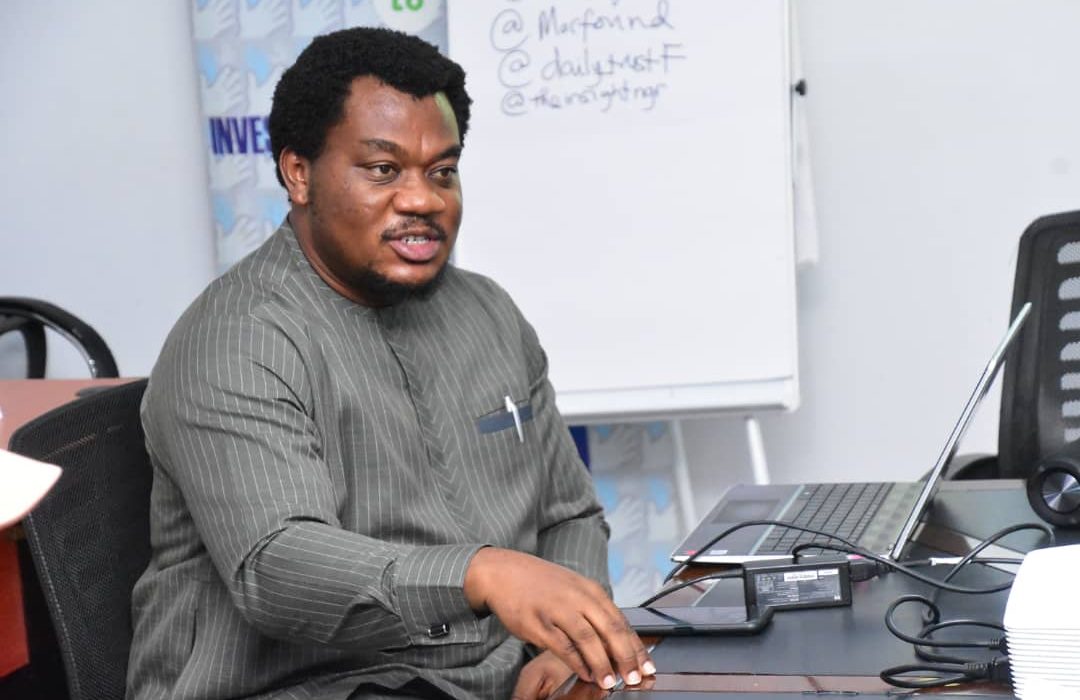
Researchers must do more than publish academic papers if they want their findings to influence public debate, government decisions and people’s lives, Taiwo George, Online Editor of Daily Trust, has said.
He argued that researchers must establish what was new about their findings, who they affected and why the public should care.
He spoke at a research communication symposium organised by AmplifyITT, where he challenged academics to communicate their findings in ways that journalists and ordinary people could understand.
“A research is not automatically a story. It becomes a story when you uncover what matters, who it affects, what it reveals, and what should happen next,” he said.
George identified discovery, significance, human impact, context and credibility as key elements that determine whether research findings attract media attention.
He said newsrooms received large volumes of information daily and had to prioritise what deserved coverage.
He explained that journalists were unlikely to give attention to information that had already been widely circulated without offering a fresh perspective.
He said research must also demonstrate why its findings matter to people’s everyday experiences, noting that readers were more likely to engage with issues they could relate to.
Using research on public trust in the police as an example, George said people would naturally be interested in findings that examined an institution with which they had direct or indirect experiences.
On credibility, he said journalists needed to establish the methodology, sample size, data and limitations of a study before relying on its findings.
“As a reporter, as a journalist, the only currency I have is trust,” he said.
He stressed that media organisations depended on public confidence in the accuracy of their reports.
George identified academic jargon, weak communication, lack of context and failure to identify the intended audience as major reasons research findings failed to become news stories.
He said researchers sometimes published papers without adequately explaining their implications.
This, he noted, leaves journalists to struggle with technical language and the task of identifying what the findings meant to the public.
He also listed questions journalists typically ask when examining research, including who funded the study, how it was conducted, what the findings confirmed, their limitations and their implications for government and society.
His position was reinforced by Dr Rilwan Abiola Kolawole, a lecturer in the Department of Communication and Language Arts at the University of Ibadan, who said the problem facing Nigerian research was not necessarily a lack of knowledge but the failure to communicate it to society.
Kolawole lamented that important discoveries made within universities rarely reached the wider public, leaving many research findings unused or inaccessible.
“How many of our researches are gathering dust?” he asked.
He argued that there must be a stronger connection between universities and the public through effective communication.
He identified journalists as a critical link in that relationship.
He said the media could translate complex academic findings into information that ordinary people could understand and use.
According to him, much of the language researchers use is designed for their academic colleagues rather than the wider society.
He urged researchers, particularly those in medicine and the sciences, to communicate in simpler language and relate their findings to issues people could readily understand.
Kolawole also criticised the barriers created by some academic journals, especially foreign ones.
He said researchers sometimes had to pay as much as $1,000 to make their work accessible, even when it was done by them, while other publications restricted access to subscribers.
He called on Nigerian universities to explore ways of making locally produced research more accessible instead of relying excessively on foreign journals.
With the 2027 general elections approaching, he urged researchers to make evidence-based studies of political and presidential candidates available to the public to support informed electoral decisions.
Also speaking, Izak Mina, a South African media consultant and former editor with the South African Broadcasting Corporation’s Digital News, called for structured partnerships between journalists and research institutions to improve factual reporting.
Mina said his experience in the broadcaster’s planning and research unit demonstrated how access to experts and research materials could strengthen newsroom coverage.
He said the unit, which supported about 17 radio stations, four to five television stations and online services across 11 languages, identified experts and available research on topical issues and made them accessible to reporters, producers and presenters.
The initiative, he said, helped journalists establish the factual basis of their reports, develop fresh angles and sometimes discover entirely new stories.
He cited a partnership with South Africa’s Council for Scientific and Industrial Research to develop an election prediction model.
He said scientists appeared on air to explain its projections, which came within about one percentage point of the final results for most political parties in the country’s last election.
Mina, however, said collaboration could be undermined by the communication gap between the two professions.
“Reporters often don’t understand scientists’ language. And the other way around, scientists don’t understand what journalists want and are often upset about how journalists use their work,” he said.
ALSO READ: Jimmy Odukoya sues sister, pastors, asks court to declare removal illegal
He recommended training programmes that would expose journalists to basic scientific principles and help researchers understand the demands of news production, including the need for concise explanations and accessible headlines.
Mina said such engagement should not end with training, but should also involve bringing journalists and researchers together to understand one another’s professional expectations.
He further advocated the use of research to strengthen media policy, citing the M20 initiative, an advocacy platform focused on information integrity, freedom of expression, media viability and the role of journalists in society.
He said the initiative was working with research organisations across Africa to develop policy briefs on information integrity, climate change reporting, artificial intelligence and journalism, and media viability.
Prof. Jerry Ugwuanyi, Deputy Vice-Chancellor of the Federal University of Environment and Technology, said Nigeria’s challenge extended beyond communicating research to translating academic findings into practical solutions, products and services.
He estimated that Nigeria produced about 70,000 indexed journal articles annually, but said much of the research remained basic and was largely driven by the need for academic promotion rather than immediate problem-solving.
“Most academics don’t get promoted because they are great teachers. They get promoted because they produce knowledge,” he said.
Ugwuanyi explained that research could be basic, applied, exploratory or translational.
He noted that while basic research expands knowledge, applied research addresses identified problems and translational research converts findings into usable products and services.
He said Nigeria needed stronger partnerships among universities, research institutes, government and industry to move research beyond academic publications.
The don compared Nigeria’s research output with South Africa’s.
He said the latter produced about 36,000 indexed journal articles but recorded greater translation of findings into practical applications.
“The reason is not that their academics are better. The reason is that the risk appetite is higher amongst their industrialists,” he said.
He identified limited industrial investment and reluctance to take risks as obstacles to commercialising research, asking: “Who is going to pay for the valorization?”
He said universities and research institutes were establishing incubation centres to identify promising findings and develop pilot projects, but argued that industrialists and investors must be willing to support their movement into the market.
Dr Olufemi Owolabi, Senior Special Assistant to the Ekiti State Governor, said research findings could influence public policy when they were presented in clear, practical recommendations and delivered to the right decision-makers at the appropriate time.
Drawing from his experience as an investigative journalist and government policy adviser, Owolabi said researchers should begin by asking what they wanted the government to do differently as a result of their findings.
“What exactly do you want the government to do differently because of this research?” he asked.
He said government institutions already had access to numerous research reports, but many were too lengthy and lacked clear recommendations that could guide action.
Owolabi illustrated the influence of research on government decisions with a review of Ekiti State’s transition committee report following the change of administration in 2022.
He said the report recommended an annual five per cent increase in capital expenditure allocation, following which the state increased its capital expenditure share from about 30 per cent to 40 per cent in the 2023 fiscal year.
The symposium was convened by James Ojo Adakole, founder of AmplifyITT, to strengthen communication between researchers, journalists and other stakeholders and improve the public use of research findings.
WATCH TOP VIDEOS FROM NIGERIAN TRIBUNE TV