

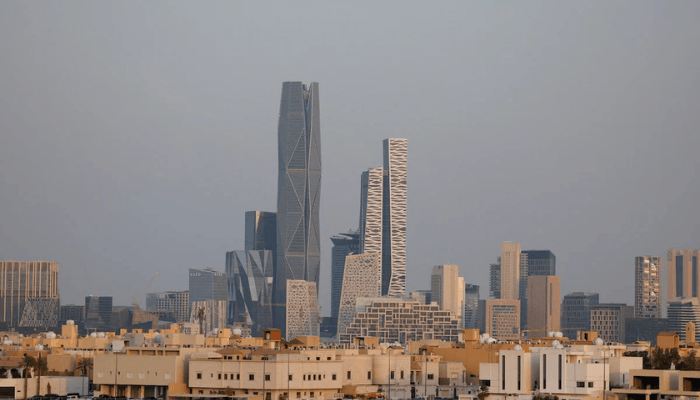
A suspected Houthi missile struck the headquarters of Saudi Arabia’s Public Investment Fund (PIF) in Riyadh on Thursday, damaging several floors of the kingdom’s tallest skyscraper and raising fresh concerns about the widening conflict in the region.
Read also: Saudi Arabia launches ‘Package Visa’ pilot for tourists
The attack shattered windows across seven to eight floors of PIF Tower, located in the King Abdullah Financial District, and damaged sections of its metal exterior. It was the second reported Houthi attack on a prominent building in Riyadh’s financial district in less than two weeks, following a November 8 strike that damaged the building of state oil company Saudi Aramco.
Three sources familiar with the incident told Reuters that the building had been hit by an incoming Houthi missile. The Saudi-led coalition fighting the group said it had “dealt with a missile threat” launched towards Riyadh, adding that its initial assessment indicated that falling debris had caused material damage.
There were no immediate reports of casualties. Authorities closed entrances to the financial district as people were evacuated, while ambulances and fire trucks responded to the scene. Residents of the capital reported hearing a loud explosion in the early hours of Thursday.
The Public Investment Fund, which manages Saudi Arabia’s sovereign wealth, acknowledged receiving a request for comment from Reuters. The Houthis had not stated the attack at the time of publication.
The strike comes as the Iran-backed group intensifies attacks on Saudi airports and oil infrastructure, following the resumption of Yemen’s long-running civil war in July amid the wider conflict involving the United States, Israel and Iran.
Read also: UAC completes sale of 43% stake in DP World Logistics to 22 Plus Invest
The fighting has also shifted in favour of the Houthis on the ground in Yemen. The group has captured additional territory from the Saudi-backed government, forcing its forces into a major retreat over the weekend.
The Houthi-run Saba news agency reported that Saudi aircraft carried out airstrikes on the group’s stronghold in Sanaa early on Thursday, although it provided no further details.
Saudi Arabia prepares for prolonged conflict
The escalating conflict threatens to disrupt Crown Prince Mohammed bin Salman’s ambitious plans to diversify the Saudi economy and reduce its dependence on oil. Saudi Arabia, the world’s largest oil exporter and a key US ally, has invested heavily in transforming its economy and attracting foreign investment.
The crown prince met Admiral Brad Cooper, head of US Central Command, in Riyadh on Wednesday. It was Cooper’s third publicly reported visit to Saudi Arabia since the Yemen conflict resumed.
Saudi officials now expect the military campaign to continue for as long as six months, according to two Western officials briefed on the kingdom’s plans, Reuters reported on Wednesday. A third source familiar with the plans confirmed the assessment.
The sources said Riyadh wants its allies to make further gains on the ground before entering negotiations with the Houthis. Saudi Arabia also replaced the commander of its coalition forces fighting in Yemen this week.
However, the military situation remains challenging for the Saudi-backed government. The Houthis have taken control of Yemen’s Red Sea coastline, including the strategically important Bab el-Mandeb Strait, and have surrounded the city of Taiz in the highlands overlooking Aden, the government’s temporary capital.
The wider regional conflict, which began in February after the United States and Israel attacked Iran, has also shown little sign of easing. Negotiations mediated by Qatar have yet to produce a breakthrough, while hostilities in the Gulf have intensified in recent days.
Iran has launched attacks towards US allies Bahrain and Kuwait, while US airstrikes hit Iran’s Qeshm Island in the Strait of Hormuz on Tuesday.
Saudi Arabia entered Yemen’s civil war in 2015, leading an Arab coalition to restore the internationally recognised government after the Houthis seized Sanaa and large parts of the country. Years of fighting produced a costly stalemate before a ceasefire was reached in 2022. That truce held until the conflict reignited this summer.

Faith Omoboye is a foreign affairs correspondent with background in History and International relations. Her work focuses on African politics, diplomacy, and global governance.